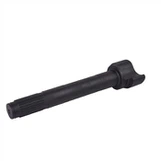
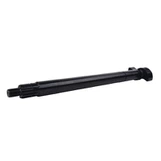
Hey there! As a front brake camshaft supplier, I often get asked about the relationship between the front brake camshaft and the brake shoes. It's a crucial topic in the world of automotive and heavy - duty vehicle braking systems, so I'm excited to break it down for you.
First off, let's understand what each of these components is. The front brake camshaft is a vital part of the braking mechanism. It's a precision - engineered shaft with a unique cam shape. The cam is designed with specific contours and angles that are crucial for its operation. When you step on the brake pedal, the force is transmitted through a series of components to the brake camshaft. This action makes the camshaft rotate.
On the other hand, brake shoes are semi - circular components housed inside the brake drum. They have a friction lining on the outer surface. When the brake is applied, the brake shoes need to press against the inner surface of the brake drum to create friction, which in turn slows down or stops the vehicle.
So, what exactly is the relationship between them? Well, the front brake camshaft acts as the driving force behind the movement of the brake shoes. When the brake camshaft rotates, the cam profile on it pushes against the brake shoes. As the cam rotates, it forces the brake shoes to expand outward. Because of the rotation of the camshaft, the brake shoes are pushed radially outwards, towards the inner surface of the brake drum.
The shape of the cam on the camshaft is critical. Different vehicles may require different cam profiles to ensure the appropriate force is applied to the brake shoes. For example, heavy - duty trucks need a more substantial force to stop, so their front brake camshafts have a cam design that can create a large amount of mechanical advantage. When the camshaft rotates, it can transfer enough force to the brake shoes to press firmly against the brake drum, despite the large mass and momentum of the truck.
In a well - functioning braking system, the cooperation between the front brake camshaft and the brake shoes is seamless. The camshaft rotates precisely according to the force applied on the brake pedal. When you lightly press the pedal, the camshaft rotates just enough to make the brake shoes gently touch the brake drum, providing a mild braking effect. If you stomp on the pedal in an emergency, the camshaft rotates more rapidly and through a larger angle, causing the brake shoes to press against the drum with full force.
For different types of vehicles, the specific design and operation of the front brake camshaft and brake shoes combination may vary. In trucks, the Camshaft for Truck has to be incredibly robust. Heavy trucks carry large loads and travel long distances, so their braking systems are under a lot of stress. The camshaft in a truck is usually made of high - strength materials and has a specific cam profile that can generate enough force to stop the heavy vehicle quickly and safely.
In the case of front - axle braking in various vehicles, the Front Axle Brake Camshaft is designed to work in harmony with the front - axle brake shoes. The front axle usually bears more weight during braking, especially in the event of sudden stops. So, the camshaft for the front axle needs to be able to transfer the right amount of force to the brake shoes to ensure effective braking.
Trailers also have their own specialized braking components. The Trailer S Camshaft is used in trailer braking systems. Trailers can vary in size and weight, but the principle remains the same. The camshaft rotates in response to the braking signal, pushing the brake shoes out to create the necessary braking force.
It's important to note that over time, both the front brake camshaft and the brake shoes will experience wear and tear. The friction between the cam and the brake shoes, as well as the continuous rotation of the camshaft, can cause the surface of the camshaft and the friction lining of the brake shoes to wear down. When the brake shoes wear out, they may not be able to create enough friction against the brake drum. Similarly, a worn - out camshaft may not be able to push the brake shoes out with the correct force.


Regular maintenance of these components is crucial. Inspecting the front brake camshaft for signs of wear, like excessive pitting or uneven surfaces, is necessary. And checking the thickness of the brake shoe lining and ensuring that it is within the safe range is equally important. If either component is worn beyond the recommended limits, they should be replaced as soon as possible to avoid braking failures.
When it comes to sourcing high - quality front brake camshafts, we pride ourselves on being a reliable supplier. Our products are engineered to the highest standards, using top - notch materials. We understand the importance of the relationship between the front brake camshaft and the brake shoes, and we design our camshafts to ensure optimal performance when paired with various brake shoes.
If you're in the market for front brake camshafts, whether it's for trucks, front - axle braking applications, or trailers, we'd love to talk to you. Properly functioning brake components are vital for the safety of any vehicle, so don't hesitate to reach out for more information or to discuss a potential purchase. We're here to help you get the best - performing front brake camshafts for your needs.
References
- Automotive Brake System Handbook
- Heavy - Duty Vehicle Mechanics Manual