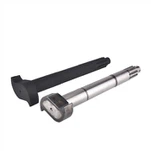
The purpose of quenching of brake camshaft is to transform supercooled austenite into martensite or bainite to obtain martensite or bainite structure, and then tempering at different temperatures to greatly improve the strength, hardness, Wear resistance, fatigue strength and toughness, etc., to meet the different requirements of various mechanical parts and tools.
The following camshaft wholesale, camshaft manufacturers and camshaft brand companies will talk about the quenching process of brake camshafts.
Put the workpiece into the inductor (coil), when an alternating current of a certain frequency is passed into the inductor, an alternating magnetic field is generated around it. The electromagnetic induction of the alternating magnetic field produces a closed induced current in the workpiece—eddy current. The distribution of the induced current on the cross section of the workpiece is very uneven, and the current density on the surface of the workpiece is very high and gradually decreases inward. This phenomenon is called the skin effect. The electric energy of the high-density current on the surface of the workpiece is converted into thermal energy, which increases the temperature of the surface layer, that is, surface heating is achieved. The higher the current frequency, the greater the current density difference between the surface layer and the inside of the workpiece, and the thinner the heating layer. Surface quenching can be achieved by rapid cooling after the temperature of the heating layer exceeds the critical point temperature of the steel.